
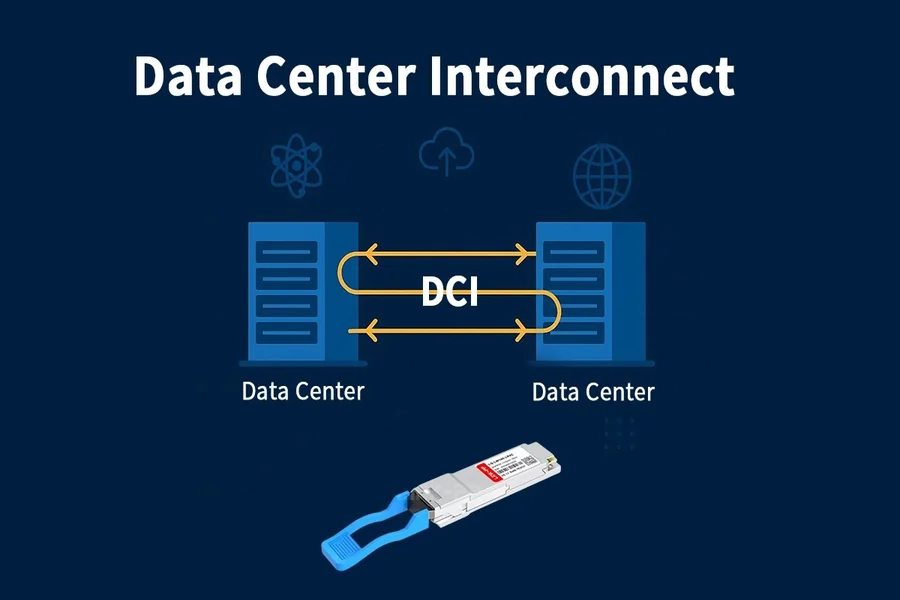
As digital transformation accelerates, modern enterprises and service providers are expanding their data center infrastructure at an unprecedented pace. Applications such as cloud computing, big data analytics, AI workloads, and disaster recovery require multiple data centers to operate as a unified system. To support these demands, reliable and high-bandwidth interconnection between data centers has become a critical requirement. This is where Data Center Interconnect (DCI) technology plays a vital role.
Among the various optical connectivity options available today, 40G QSFP+ modules remain a highly practical and cost-effective solution for medium- to long-distance links. While higher-speed technologies such as 100G and 400G are increasingly popular, many organizations still rely on 40G infrastructure for backbone connectivity due to its maturity, affordability, and compatibility with existing network equipment. For interconnections that need to span tens of kilometers, the 40GBASE-ER4 QSFP+ optical transceiver has proven to be one of the most reliable choices.
The 40G ER4 module is specifically designed to support transmission distances of up to 40 kilometers over single-mode fiber using the 1310nm wavelength band. This long-reach capability makes it ideal for connecting data centers located in different buildings, campuses, or even different metropolitan locations. Understanding why 40G ER4 is particularly suitable for DCI scenarios helps network planners design more stable and efficient interconnection architectures.
The Growing Need for Long-Distance Data Center Interconnect
Cross-Building and Cross-Campus Connectivity Challenges
In many real-world deployments, a single organization often operates multiple data centers instead of one centralized facility. These data centers may be located in separate buildings within the same campus or distributed across different areas of a city. To ensure business continuity and efficient resource sharing, these sites must be connected with high-speed and low-latency links.
However, connecting geographically separated data centers presents several challenges. Standard short-reach optical modules such as SR4 or LR4 are typically limited to distances of a few hundred meters or up to 10 kilometers. While these solutions are effective for intra-data center networking, they are often insufficient for inter-building or inter-campus connections where fiber distances can easily exceed 10 or 20 kilometers. In such cases, organizations require a more powerful and longer-reach optical solution.
The 40GBASE-ER4 transceiver addresses this requirement by providing stable 40Gbps connectivity over distances of up to 40 kilometers. This capability allows enterprises to establish high-performance links between remote facilities without the need for expensive optical amplification equipment. As a result, 40G ER4 has become a preferred technology for medium-range DCI deployments.
Technical Advantages of 40G ER4 for DCI Environments
Designed for Long-Reach Optical Transmission
The 40G ER4 optical module is built using advanced wavelength division multiplexing (WDM) technology. It transmits four independent 10Gbps optical signals over four wavelengths around the 1310nm band and combines them onto a single pair of single-mode fibers. This architecture enables efficient long-distance transmission while maintaining high signal integrity.
Unlike short-reach multimode solutions, 40G ER4 is optimized for single-mode fiber infrastructure, which is commonly used in metropolitan and campus networks. Single-mode fiber offers significantly lower attenuation and dispersion over long distances, making it ideal for inter-data center links. With support for up to 40 kilometers, ER4 modules can easily cover the typical distances required for cross-building or cross-campus connections.
High Reliability and Stability for Mission-Critical Links
Data center interconnect links often carry mission-critical traffic, including real-time replication, backup data, and application synchronization. Any interruption or degradation in these links can directly impact business operations. Therefore, reliability is one of the most important considerations in DCI design.
The 40G ER4 module is engineered to deliver stable optical performance under demanding conditions. It typically uses high-quality EML lasers and APD receivers, which provide better sensitivity and signal quality compared to short-reach alternatives. In addition, built-in Digital Diagnostic Monitoring (DDM) functions allow network administrators to monitor parameters such as optical power, temperature, and voltage in real time. These features help ensure continuous and predictable operation of long-distance links.
Cost-Effective Solution for Medium-Range DCI
Balancing Performance and Investment
While higher-speed options such as 100G or 400G may seem attractive, they are not always necessary for every DCI scenario. Many organizations only require 40Gbps bandwidth for data replication or inter-site communication. In these cases, deploying 40G ER4 modules provides an ideal balance between performance and cost.
Compared with deploying 10G links in parallel, a single 40G ER4 connection simplifies network architecture and reduces cabling complexity. At the same time, it avoids the higher equipment and power costs associated with upgrading to 100G platforms. For enterprises looking to extend the life of their existing 40G infrastructure, ER4 transceivers offer a highly economical path to long-distance connectivity.
Seamless Integration with Existing Networks
Another important advantage of 40G ER4 in DCI applications is its strong compatibility with current network environments. Many switches and routers already support QSFP+ interfaces, allowing ER4 modules to be deployed without major hardware upgrades. Organizations can reuse their existing single-mode fiber cabling and achieve long-distance interconnection simply by replacing short-reach transceivers with ER4 modules.
This flexibility makes 40G ER4 an attractive option for gradual network expansion. Instead of performing a costly and disruptive full network upgrade, businesses can incrementally enhance their DCI capabilities while maintaining operational continuity.
Conclusion
Data center interconnect has become a fundamental requirement for modern IT infrastructure. As organizations distribute workloads across multiple locations, the need for reliable, long-distance, and high-bandwidth connectivity continues to grow. The 40GBASE-ER4 QSFP+ optical transceiver is specifically designed to meet these demands by enabling stable 40Gbps transmission over distances up to 40 kilometers.
For cross-building and cross-campus scenarios, 40G ER4 provides an optimal combination of reach, performance, and cost efficiency. Its compatibility with single-mode fiber, advanced optical design, and robust monitoring capabilities make it a dependable choice for mission-critical DCI deployments. Even in an era of rapidly evolving higher-speed technologies, 40G ER4 remains a practical and proven solution for organizations seeking to build scalable and reliable inter-data center networks.
