
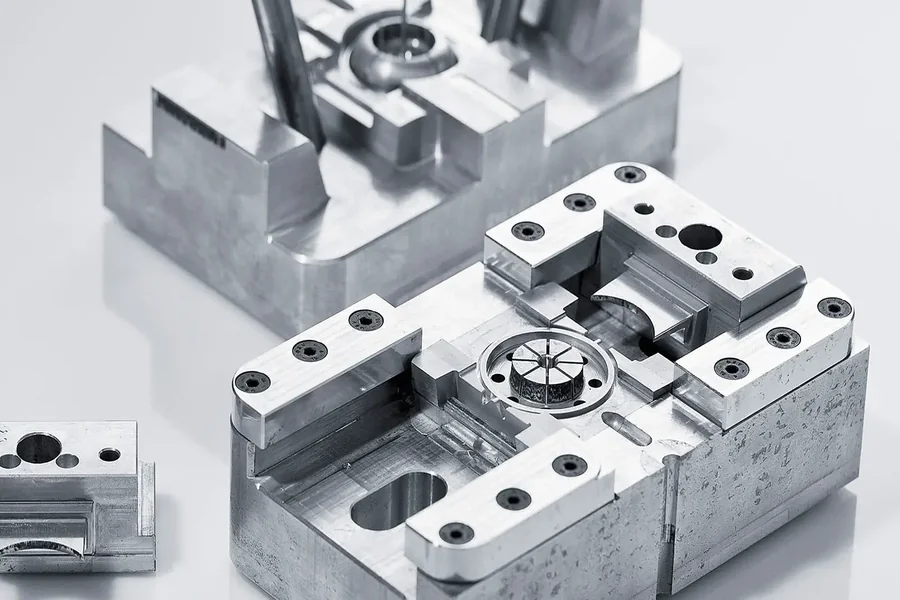
An overmolding service bonds rigid and soft materials into one part, and a rapid tooling service delivers the mold in weeks, cutting launch time and cost.
Product teams rarely lose time on design. They lose it waiting for a mold. The newly launched overmolding service and rapid tooling service from [Company Name] target that exact bottleneck: one fuses rigid and soft materials into a single finished part, the other puts the production tool in your hands in weeks instead of months. Paired, they let you test something that looks and feels like the final product before you commit to hardened steel.
What Is an Overmolding Service?
An overmolding service molds one material, usually a thermoplastic elastomer (TPE or TPV), directly onto a second, rigid substrate to create one multi-material part. A toothbrush handle is the textbook example: hard plastic core, soft grip on top.
Engineers choose it for practical reasons. It improves grip, dampens vibration, adds a second color or brand cue, and replaces assemblies that would otherwise need adhesives, screws or extra labor. Fewer assembly steps usually means fewer failure points.
Where Overmolding Pays Off
Medical devices, power tool handles, consumer electronics and automotive trim are the usual homes for it. Surgical instruments need a secure, cleanable grip. Handheld electronics need shock protection without a bulky case. Some shops also overmold around metal inserts; one provider reports parts carrying more than 37 inserts in a single molding.
Bonding Is the Hard Part
Here’s the catch most product pages skip: overmolding only works if the two materials actually stick. Bonding is either mechanical (undercuts and holes the soft material locks into) or chemical (compatible polymers that fuse). Pick incompatible materials and the grip peels off in the field. Material pairing deserves a conversation before you finalize CAD, not after the first sample fails.
What Is a Rapid Tooling Service?
A rapid tooling service builds injection molds quickly, most often from CNC-machined aluminum such as 6061 or 7075, so you can mold real parts in production-grade resin without waiting for a full steel tool. Aluminum machines roughly five to ten times faster than steel, according to Formlabs, which is where most of the time savings come from.
Providers commonly claim 40-50% lower tooling cost and 40-60% shorter lead time against conventional molds. Treat those as vendor figures, not guarantees; they depend on part size, cavity count and finish. Still, the direction is consistent across the industry.
How Many Parts Can a Rapid Tool Make?
Quantities vary by tool material. One mold maker splits its offering into prototype or bridge tooling for roughly 50 to 2,000 parts and short-run tooling for 1,000 to 100,000. Aluminum wears faster than steel, so very high volumes eventually justify a hardened production tool. For launches, pilot builds and bridge production, aluminum is usually the smarter spend.
How Do Overmolding and Rapid Tooling Work Together?
Overmolding needs more than a standard tool. You’ve got a substrate mold, an overmold cavity and often a transfer or insert step. Building that setup in steel before you know the design works is an expensive gamble.
Rapid tooling changes the math. You mold the substrate and the soft layer in aluminum, find out whether the bond holds, whether the grip feels right and whether the wall thickness flows properly, then adjust. A design change on a soft tool often means a modest insert tweak rather than re-cutting hardened steel.
That feedback loop is why the combination is worth more than either service alone. For a team shipping a medical handle or a rugged enclosure, the first overmolded samples can arrive while the competition is still waiting on a quote for a steel tool.
What Should You Check Before You Order?
A few questions save weeks later:
- Material compatibility: Does the overmold resin bond to your substrate, and is the bond mechanical, chemical or both?
- Design for manufacturing feedback: Does the quote include a review of wall thickness, draft and undercuts?
- Tool life: How many shots will the aluminum tool realistically survive for your resin?
- Scale-up path: Can the same design move to a steel tool later without a redesign?
- Finishes: Are texture and color options available for the soft layer?
Be honest about the limits, too. Rapid tools can’t match steel for endurance, and very fine features or tight tolerances may push you toward conventional tooling. The right choice depends on volume and timeline, not on which service sounds faster.
[link to related post on injection molding design guidelines] [link to related post on TPE vs. silicone material selection]
Conclusion
An overmolding service gives a part its grip, durability and polish in a single molded piece, and a rapid tooling service gets the mold built before the market moves on. Start with a design review, confirm the material pairing early, and plan your path from aluminum to production tooling. Ready to test a design? Upload your CAD file for a quote and manufacturability feedback.
