
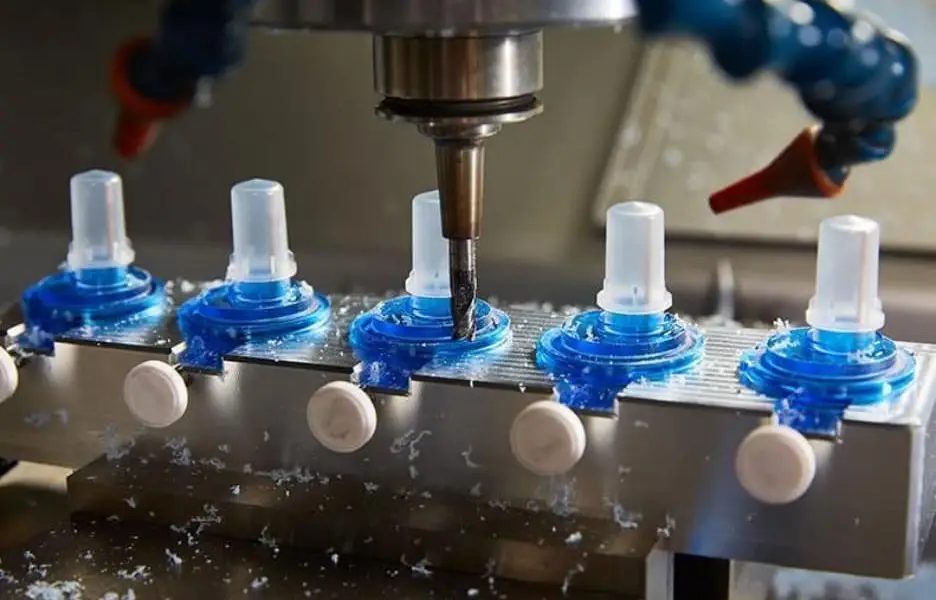
A phone case with a soft grip, a power tool handle that doesn’t slip, a medical device with a sealed rubber edge. None of these are assembled from separate pieces. They’re molded as one. That’s the job of an overmolding service, and when you pair it with a rapid tooling service, you can get from CAD file to working parts before a traditional steel mold would even be finished. This guide explains how each service works, where they overlap, and where each one falls short.
What Is an Overmolding Service?
Overmolding is an injection molding process in which a second material is molded over or around a first one, called the substrate, so the two end up as a single part. An overmolding service handles the mold design, material pairing, and molding runs for you.
The substrate is usually a rigid plastic such as ABS, nylon, or polycarbonate. The outer layer is typically a softer material: TPE, TPU, or silicone. Metal inserts work as substrates too, which is how you get threaded bosses or electrical contacts locked inside plastic.
Why not just glue or snap the parts together?
Assembly adds labor, adds failure points, and leaves seams where dirt and moisture collect. A molded bond removes the seam. It also lets you combine properties no single resin offers, such as a stiff frame with a cushioned, high-friction surface.
Chemical vs. mechanical bonding
Two things hold an overmold in place. Chemical bonding happens at the interface between compatible materials. Mechanical bonding relies on geometry: holes, undercuts, and textured surfaces that the second material flows into and grips.
Here’s the practical advice: if the bond matters to your product’s safety or durability, don’t rely on chemistry alone. Material compatibility charts are a starting point, not a guarantee, and a cooled substrate bonds less readily than a freshly molded one. Build in some mechanical interlock as insurance.
What Is a Rapid Tooling Service?
A rapid tooling service builds injection molds faster and cheaper than conventional production tooling. It does this mainly by using aluminum instead of hardened steel, simplifying the mold design, and starting from standard mold bases rather than custom-machined ones.
The time difference is real. Many production steel tools take around 6 to 8 weeks after design approval, while rapid tools commonly come together in roughly 2 to 5 weeks. Cost drops too. One moldmaker has cited a single-cavity aluminum mold at about $5,000 against roughly $15,000 for a four-cavity steel mold, though prices vary widely by part size and complexity, so treat any single figure as a rough marker.
How many parts can a rapid tool make?
It depends on the material and the part. Aluminum tools wear faster than hardened steel, so they suit prototypes, pilot runs, and low-volume production rather than millions of units. If your forecast runs into six figures of parts, a steel tool will eventually pay for itself.
The aluminum debate
Not everyone agrees that aluminum is the right answer. Some rapid tooling providers have moved entirely to soft steels like P20, arguing that aluminum is harder to repair, easier to scratch during polishing, and not as much faster to build as its machinability suggests, since much of the lead time is spent on work that takes the same time in either metal. They have a point. For parts with fine cosmetic requirements, or runs likely to grow, a rapid steel tool deserves a quote alongside the aluminum one.
Using Both Services Together
Overmolding is one of the best candidates for rapid tooling, and the reason is simple: it’s hard to get right on the first try. Two materials means two sets of shrink rates, two melt temperatures, and an interface that has to hold up under real use. Discovering a bonding problem after cutting a steel production mold is an expensive way to learn.
A rapid tool lets you test the combination first. Some overmolding providers quote prototype parts in as little as 15 days using aluminum molds, which gives you time to run pull tests, drop tests, and fit checks with production-grade resins.
A sensible workflow
- Pick a material pair based on the function of the soft layer: grip, sealing, vibration damping, or appearance.
- Design for bonding with mechanical features included from the start.
- Build a rapid tool and mold a pilot batch.
- Test the bond under the conditions the product will actually face, including heat, flexing, and cleaning chemicals.
- Adjust, then commit to production tooling once the design stops changing.
What to watch for
Rapid tooling has limits that matter more in overmolding than in single-shot work. Side actions, undercuts, and tight tolerances can push up cost or lead time on aluminum tools, and simplified cooling can lengthen cycle times. Ask any provider how many shots the tool is rated for before you plan a bridge-production run around it.
Conclusion
An overmolding service gives you a single, seamless part with combined properties. A rapid tooling service gives you a fast, affordable way to prove that part works before you commit to steel. Use them together early, test the bond hard, and treat the first tool as a learning investment rather than the final one. When you request quotes, send the 3D model, your material preferences, and your expected volumes, and the answers you get back will tell you quickly which providers understand the process.
