
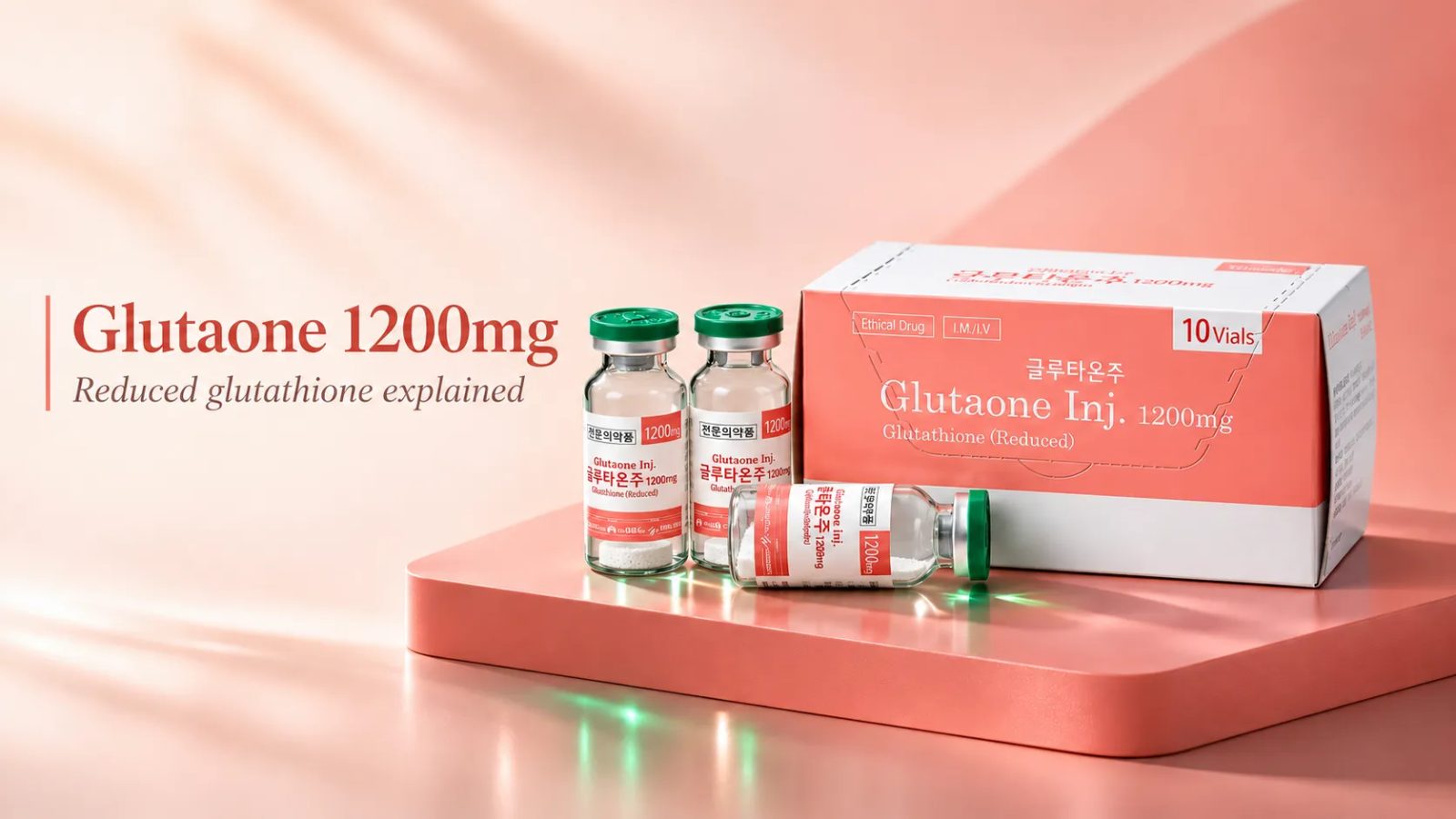
Glutaone is a reduced-glutathione preparation supplied as a dry product in a vial. Three details explain most of its identity: glutathione is the active molecule, “reduced” describes its chemical state, and “1200mg” states the labeled amount per vial. The freeze-dried presentation describes how the product is manufactured and stored, rather than a different kind of glutathione or a promise of greater clinical benefit.
Understanding these distinctions makes product comparisons more useful. A larger number on a carton does not establish a better outcome, and an antioxidant’s biological importance does not prove every claim made for a commercial preparation. The practical starting point is to separate molecular chemistry, formulation characteristics, and evidence for a particular use.
The Korean Pharmaceutical Information Center’s entry for Glutaone identifies reduced glutathione at 1,200 mg per vial, with a ten-vial pack and a white, porous solid presentation. The entry names Kuhnil and lists sodium bicarbonate as an excipient. These details establish product identity; they do not establish a cosmetic treatment protocol. The recorded Korean indication concerns prevention of neurological complications associated with cisplatin or related chemotherapy. [1]
The Glutaone 1200mg listing provides a product reference for the ten-vial presentation. When discussing it, keep the active amount separate from pack size. “Ten vials” is an inventory quantity. It is not a recommendation for ten sessions or a complete course of treatment.
This distinction also prevents confusion with similarly named glutathione products. A shared brand word, or the same headline ingredient, does not automatically establish the same manufacturer, composition, dosage form, or clinical evidence.
Reduced and oxidized glutathione are different chemical states
Glutathione is a tripeptide made from glutamate, cysteine, and glycine. The cysteine component supplies a sulfur-containing thiol group that is important to its chemistry. The reduced form is commonly abbreviated GSH. Two glutathione molecules can become linked through a disulfide bond, forming oxidized glutathione, abbreviated GSSG. [2,3]
“Reduced” is therefore a chemical description, not a description of weaker strength, smaller particles, or reduced manufacturing steps. Nor does “oxidized” simply mean counterfeit or useless. GSH and GSSG participate in a biological redox system, and their relationship matters in discussions of cellular chemistry.
A helpful analogy is to distinguish the identity of a rechargeable component from its current state. The analogy has limits, but it explains why a report about “total glutathione” may not answer the same question as a report specifically measuring reduced glutathione. If a study measures one and a product discussion mentions the other, the terms need to be reconciled before drawing conclusions.
For readers comparing technical material, three questions are useful: Which form was measured? Was the measurement made in a vial, blood, or tissue? And what clinical outcome, if any, was linked to that measurement?
A biological role is different from a product outcome
Cells make and regulate their own glutathione. Lu’s review describes a controlled synthesis pathway rather than an unlimited pool that simply rises in direct proportion to an external amount. [2] That background explains why glutathione attracts scientific interest, but it does not turn a vial strength into a prediction of skin appearance or general wellness.
Product evaluation becomes clearer when the question is specific. “What is glutathione?” is a chemistry question. “What does this preparation contain?” is a formulation question. “Does this preparation improve a defined condition in a defined population?” is a clinical question. A source that answers the first cannot automatically answer the third.
This is particularly important when an article moves from the familiar word “antioxidant” to a list of unrelated benefits. Each claimed outcome needs its own evidence, including the actual formulation, the population studied, the comparator, and the assessment period.
What 1200mg does and does not mean
The number represents mass. It does not state liquid volume, concentration, bioavailability, purity, or an appropriate amount for an individual. Those are separate properties with different units and different evidence requirements.
For example, comparing a 600 mg presentation with a 1,200 mg presentation tells you that the second label declares twice the active mass per vial. It does not show that the second produces twice the benefit. A response can depend on factors that the front of the carton does not describe, including the clinical question and how an outcome is measured.
Concentration requires both an amount and a volume. Because a dry vial is not a final liquid concentration, the label cannot be converted into a practical administration instruction just by reading the headline number. Professional preparation and use belong to the product’s applicable instructions and the treating clinician’s decision.
A more useful comparison sheet keeps four fields separate: active identity, active amount per unit, dosage form, and units per pack. Putting them in separate columns prevents a larger carton or larger mass from being mistaken for stronger evidence.
Why a freeze dried product looks different
Lyophilization removes water from a frozen formulation under reduced pressure. The FDA’s technical guide describes freezing, primary drying through sublimation, and secondary drying. The purpose is a suitable dry presentation with characteristics established for that formulation; it is not a method for creating a new active molecule. [4]
The porous appearance of a freeze-dried cake can surprise someone expecting a loose powder. A porous solid and a powdery-looking presentation are not interchangeable visual standards, and photographs cannot establish chemical potency. Appearance is only one characteristic of a manufactured product.
Dry storage and liquid storage also pose different technical questions. A shelf-life claim for the unopened vial should not be extended to material after preparation. Likewise, “freeze dried” does not mean the carton belongs in a household freezer. Storage instructions are product-specific and take priority over assumptions based on the manufacturing term.
For a professional comparing formats, the central question is not whether dry material looks more advanced. It is whether the presentation fits the intended clinical setting and has relevant stability information. A well-designed liquid preparation and a well-designed lyophilized preparation can solve different formulation problems.
| Term | What it describes | What it cannot establish alone |
| Reduced glutathione | The GSH chemical form | A guaranteed clinical outcome |
| 1200mg | Labeled active mass per vial | Final concentration or individual requirement |
| Lyophilized | A freeze-dried presentation | Greater efficacy than every liquid format |
| Ten vials | Pack quantity | A treatment schedule |
| Antioxidant | A biochemical role | Evidence for every advertised benefit |
How to read a glutathione study without overinterpreting it
Start with the actual question being tested. A laboratory experiment may explore a chemical reaction, while a clinical study may assess a symptom, a biomarker, or an appearance-related outcome. These endpoints answer different questions and should remain distinct in a product discussion.
Next, identify the preparation. An oral supplement, a topical cosmetic, and an injectable medicine are different presentations. Even when the ingredient name matches, evidence from one format is not a shortcut to conclusions about another. The same caution applies when a study evaluates a combination rather than glutathione alone.
Then look at the comparison and follow-up. A before-and-after observation can describe change, but it cannot by itself show what would have happened without the intervention. If a result is reported as a percentage, ask what was counted and whether the change was meaningful to the person being treated.
Finally, compare the conclusion with the data. “A biomarker changed” is narrower than “health improved,” and “participants reported a difference” is narrower than “the product has a predictable effect.” Accurate interpretation keeps the size and meaning of each finding clear.
A practical way to organize product discussions
Consider a hypothetical purchasing meeting in which one team member focuses on price per box and another focuses on the active amount. Both can be correct about the numbers while discussing different things. A useful product summary begins by naming the unit being compared and the purpose of the comparison.
For an inventory decision, pack size and unit cost are relevant. For a formulation discussion, the active form and dosage presentation matter. For a clinical decision, the patient’s needs and evidence for the proposed use take priority. Combining these conversations into a single claim such as “higher strength is better value” loses information.
A concise product brief can therefore record the product identity, presentation, and supporting clinical question in separate sentences. This keeps communication concrete and avoids vague promises about “detox,” “radiance,” or “cellular renewal” that do not specify a measurable result.
Frequently asked questions
Is reduced glutathione the same as ordinary glutathione
In product descriptions, “glutathione” often refers to GSH, but the full specification matters. “Reduced glutathione” explicitly identifies the reduced form. In research, the word can appear in discussions of GSH, GSSG, or total glutathione, so the terminology should be checked rather than assumed.
Does 1200mg mean the vial contains only that ingredient
No. The labeled active amount and the complete formulation are different pieces of information. The Korean product entry also lists sodium bicarbonate as an excipient. [1] An active-strength statement should never be treated as a complete ingredient list.
Does freeze drying make glutathione more effective
Freeze drying is a manufacturing and stability strategy. It does not, on its own, demonstrate a better clinical result. A claim of superiority requires an appropriate comparison of actual products and relevant outcomes, rather than a comparison of manufacturing terminology.
Can a study of oral glutathione support claims about this vial
It may provide background about the molecule, but it does not directly establish the performance of a different presentation. Read the study’s formulation and endpoints before deciding how closely it relates to the specific product under discussion.
Is antioxidant activity proof of a skin lightening effect
No. Antioxidant chemistry and a visible pigmentation outcome are different endpoints. A plausible mechanism may help explain a research question, but a specific appearance claim still needs clinical evidence for the formulation and use being discussed.
Explore the product with a clear question
When reviewing aesthetic products from FillersFairy, compare named formulations and presentations rather than headline benefit lists. For Glutaone, begin with reduced glutathione, the labeled active mass, and the lyophilized format. Ask a qualified clinician to connect those product facts to a defined clinical need and the evidence relevant to it.
References
1. Korea Pharmaceutical Information Center. Glutaone Inj. 1200mg product information based on Ministry of Food and Drug Safety records. Accessed 2026.
2. Lu SC. Glutathione Synthesis. Biochimica et Biophysica Acta. 2013;1830:3143-3153.
3. Alcock LJ, Perkins MV, Chalker JM. Chemical Methods for Mapping Cysteine Oxidation. Chemical Society Reviews. 2018;47:231-268.
4. US Food and Drug Administration. Guide to Inspections of Lyophilization of Parenterals. 1993.